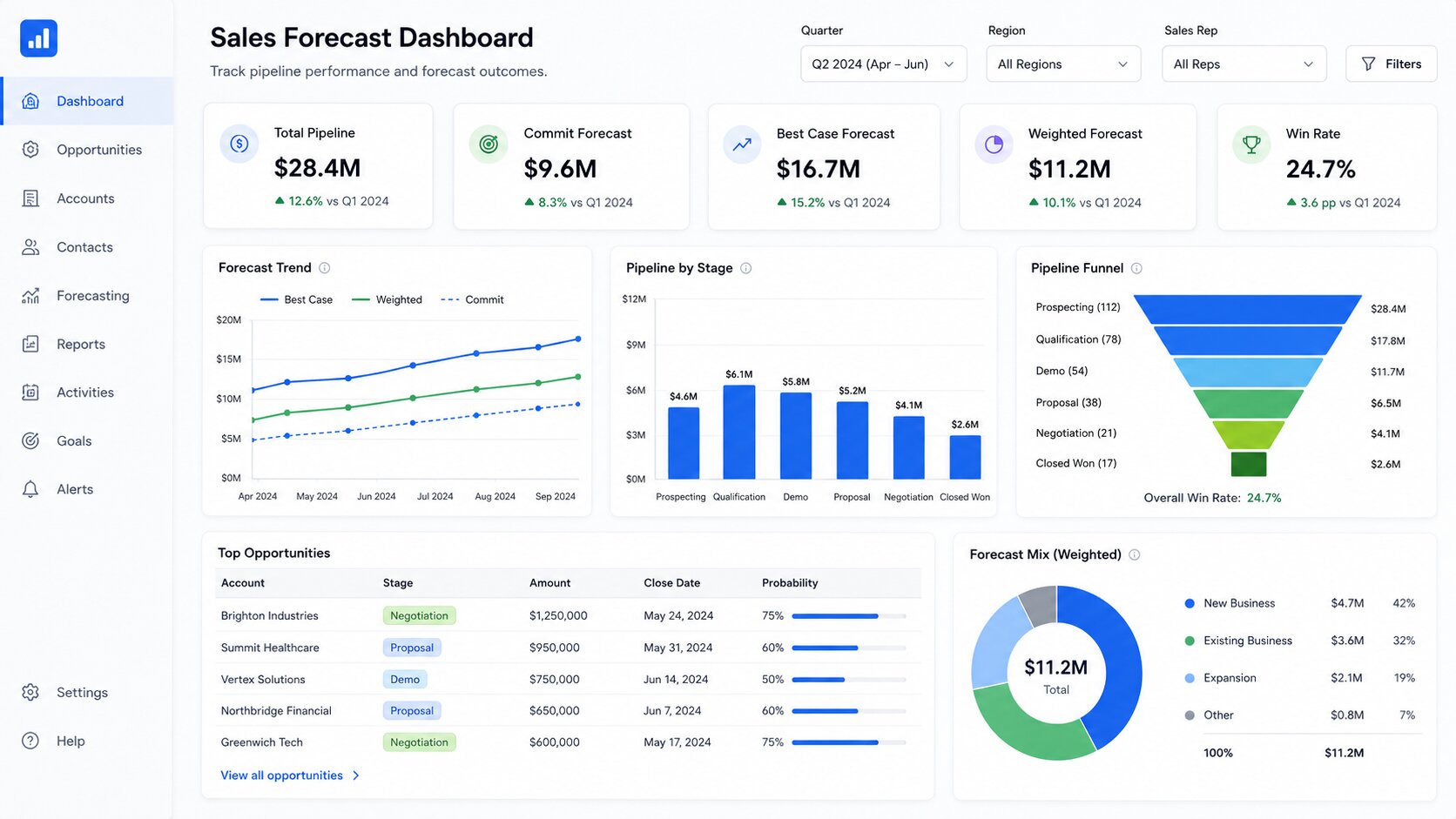
There is a shortcut that has entered the bloodstream of B2B sales over the past decade and refuses to leave: the “3x pipeline coverage” rule.
The rule is stated with the confidence of a physical law. You need three times your quota in pipeline to hit your number. Anything less and you’re under-covered. Anything more and you’re safe. CROs report it to their boards. Sales leaders use it to set SDR quotas. RevOps teams build dashboards around it. New reps are taught it in their first week.
It is, almost without exception, wrong.
Not directionally wrong — structurally wrong. Pipeline coverage as a single dollar multiple is one of the most misleading shortcuts in the B2B sales playbook, and the comfort it provides is often the thing that hides the structural problem in the pipeline until it’s too late to do anything about it.
What Coverage Ratios Actually Measure
A 3x coverage ratio assumes a 33% win rate on the pipeline you’re counting. That’s the math: $3 of pipeline, you close $1, you hit your number. The problem is that this assumption breaks the moment any of the following is true:
- Your actual win rate isn’t 33%.
- Your pipeline isn’t homogeneous (i.e., late-stage deals don’t actually close at the same rate as early-stage deals).
- Stage definitions vary across reps or segments.
- Pipeline is back-loaded into the last weeks of the quarter.
In other words, the 3x rule works perfectly if your pipeline is uniform, your win rate is exactly 33%, and your stage definitions are perfectly consistent. For exactly zero B2B organizations I have ever worked with, all three conditions are true.
“Coverage ratios are a comfort blanket. They tell you the pipeline is ‘big enough’ without ever asking whether it’s real enough.”
— Dalton Ezri
What Goes Wrong in Practice
I’ve seen the failure mode of pipeline-coverage thinking play out in nearly the same way many times.
A team enters a quarter with 3.2x coverage. Leadership feels confident. The forecast call confirms commit and best-case numbers that imply the quarter is in good shape. By week six of a thirteen-week quarter, slippage starts appearing — a few late-stage deals push out, a few mid-stage deals stall. The team’s response is to redouble outbound activity to “rebuild coverage” — but the new pipeline being created is too early to close in the current quarter. It just inflates the dollar denominator without changing the closeable numerator.
By the end of the quarter, the team has 4.1x coverage and misses the number by 15%.
This isn’t a hypothetical. It’s almost a script. The coverage ratio held; the win rate didn’t.
Industry data from Forecastio and from Gartner consistently show roughly 60% of forecasted deals slipping to the next quarter, with median forecast accuracy in the 70–79% range. Those numbers are not the symptom of insufficient coverage — they are the symptom of coverage measured at the dollar level instead of the stage-progression level.
The Stage-Progression Alternative
The coverage model I install with teams replaces the single multiple with a stage-progression view that measures coverage by stage, weighted by realistic per-stage win rates, and re-cut by segment.
The basic structure is straightforward:
For each stage, calculate: historical conversion rate to closed-won, weighted by segment if win rates differ meaningfully across segments. Then, for the current quarter’s plan, calculate the closeable pipeline — the sum of pipeline at each stage multiplied by the stage’s historical conversion-to-close for deals that close in the current quarter, not deals that ever close.
That last clause is where most coverage models fail. A deal in early stage might have a 30% chance of ever closing. But its chance of closing this quarter is closer to 5%, because it has too many stage-gates left to navigate in the time remaining. A stage-progression coverage model accounts for this; a flat 3x model doesn’t.
The teams that adopt this model find, in the first quarter, that their “real” coverage is dramatically lower than their dollar coverage suggested. A team showing 3.5x dollar coverage might have stage-progression coverage of only 1.4x. That’s not a coverage shortage — that’s a coverage fiction being exposed.
The Re-Cuts That Reveal the Real Problem
Once you have stage-progression coverage as your baseline metric, the most useful diagnostic is re-cutting it three ways:
By segment. Coverage is rarely uniform across SMB, mid-market, and enterprise. A 1.5x coverage in your highest-converting segment is worth more than a 5x coverage in your lowest. Aggregate coverage hides this.
By rep tenure. New reps and ramped reps have different effective conversion rates. A pipeline that’s 70% owned by reps in their first six months looks healthy on dollar terms and is structurally fragile in conversion terms.
By age in stage. Pipeline that has been stuck in late stage for 90+ days is, statistically, mostly dead pipeline. It inflates coverage without contributing to forecastable revenue. The teams that get serious about pipeline hygiene re-stage or remove these deals — and the act of doing so usually shrinks coverage by 15–25% and improves forecast accuracy.
“The teams that hit their number consistently aren’t the ones with the most pipeline. They’re the ones who know which pipeline is actually closeable this quarter — and which is dressed up to look closeable.”
— Dalton Ezri
Why This Matters for Forecasts
The forecast accuracy data I cited earlier — 60% slippage, sub-80% median accuracy — isn’t a forecasting tool problem. It’s a coverage-measurement problem dressed up as a forecasting problem. When the underlying coverage model is wrong, even the best forecasting process produces wrong answers.
Conversely, teams that move to a stage-progression coverage model with segment and tenure re-cuts almost always see forecast accuracy improve in the next two quarters, often by 15+ percentage points. The number of inputs hasn’t changed. The reps haven’t gotten more honest. The CRM hasn’t gotten cleaner. What’s changed is that the team is now measuring closeable coverage instead of gross coverage — and the forecast naturally aligns with reality.
Running This in Your Organization
If you’re a CRO who routinely talks about your coverage ratio in board updates, the diagnostic question I’d suggest is this: what is your team’s actual stage-by-stage conversion rate to closed-won within the same quarter — not ever-converted, but same-quarter? If you don’t know that number, your coverage ratio is, at best, a comfort metric and at worst an active source of false confidence.
The fix isn’t a new dashboard. It’s a willingness to look at coverage through the lens of stage progression, segment heterogeneity, and same-quarter closeability — and to make resource and forecast decisions on the basis of that view instead of the simple multiplication shortcut.
The 3x rule isn’t useful. Same-quarter closeable pipeline by segment, weighted by realistic stage conversion, is useful. The former is comforting. The latter is honest.
Dalton Ezri works with sales leadership teams to rebuild pipeline coverage and forecast models that reflect actual closeability instead of dollar-multiple shortcuts — from stage-progression analysis to segment-cut coverage to pipeline-hygiene processes that strip false coverage out of the picture. If your forecast keeps missing despite “healthy” coverage, the coverage model is the problem.